
Bath County Projected Versus Actual
A projected release date is a calculation based on the sentence, credit posted so far, and rules that apply to the case. It can move. Actual release is the event recorded when the person leaves one custodian. The destination matters because release from Montgomery, Rowan, or Three Forks to KY DOC is a transfer, not a community release.
Pretrial Bath County detainees usually do not have a sentence-based projected date. Bond, dismissal, plea, sentencing, a new order, or another hold may control. The Bath court file can show legal authority, while the jail that actually has custody can explain current processing. For state prisoners, KOOL may show a projected or expiration date, but the label must be preserved.
Find Bath County Projected Dates
Begin by deciding whether the person is pretrial, serving a local sentence, or serving a state sentence. Bath County has no verified operating jail or single jail roster. Its detainees may be held at three contracted facilities. A local release inquiry must therefore go to the actual holding jail and the Bath court. A state sentence belongs in the Kentucky Online Offender Lookup.
- Identify the present custodian through the arresting agency, court, or current roster.
- For a pretrial person, check bond and the latest Bath court order.
- For a local sentence, ask the holding jail for its sentence and release calculation.
- For a state sentence, search KOOL by name or DOC or PID number.
- Copy the complete date label, not just the number.
- Check parole history, supervision, holds, and later court action.
- After the date passes, confirm the actual event through VINE and the agency record.
The Bath County released inmate search provides the broader path when the person has already left a roster. A roster absence alone cannot tell whether the person went home or moved to another jail or prison.
KOOL Bath County Date Labels
KOOL’s search form calls its filter “Projected Release Date From/To.” A state detail record may instead display “Minimum Expiration of Sentence Date (Good Time Release Date).” It can also show Expected Time to Serve, parole eligibility, maximum expiration, convictions, location, supervision dates, and parole history. Those are different milestones.
| KOOL item | How to read it |
|---|---|
| Projected Release Date From/To | A search range, not final proof of release |
| Minimum Expiration of Sentence Date | The good-time release date label used on a detail record |
| Expected Time to Serve | A sentence estimate under current data |
| Parole eligibility | When Board review may become possible |
| Maximum expiration | The outer sentence-expiration milestone shown |
| Current location or supervision | Where the state record presently places the person |
Do not collapse all of these into “release date.” Parole eligibility can arrive before sentence expiration, and a projected expiration can change as credits or orders change. KOOL data newer than 120 days may not be finalized, and daily updates are not certified real time.
Compute Bath County Release Dates
Kentucky sentence computation begins with the judgment and sentence length. Prior confinement credit under KRS 532.120 can count time already spent in custody. Consecutive sentences, which run one after another, are aggregated. DOC then applies only the credits and restrictions authorized for the person’s case. The result is a working date, not a simple subtraction anyone can reproduce from a roster.
KRS 197.045 provides several credit categories. It permits 90-day credits for approved educational credentials and up to 90 days for approved treatment, evidence-based, or life-skills programs. DOC may award up to ten days per month for good behavior. Limited meritorious or emergency-service credits also exist. Credits can be forfeited, and future credits can be denied after rule violations. Sexual-offender treatment provisions can withhold credits subject to the statute’s terms.
The correct computation is case-specific. Confirm the sentence, offense date, concurrent or consecutive structure, credit ledger, and any statutory restriction with KY DOC. A county holding jail may calculate a local sentence under a different operational record and should be asked directly. No Bath-specific local earned-time formula was found, so one should not be inferred.
- Jail credit
- Time in custody credited toward the sentence.
- Good time
- Credit allowed under law and DOC rules that may advance an expiration date.
- Consecutive
- Sentences served one after another rather than at the same time.
- Maximum expiration
- The later sentence-end milestone before applicable adjustments.
Bath County Violent-Offender Limits
Kentucky does not impose one universal 85 percent rule on every sentence. Under the version of KRS 439.3401 effective July 15, 2026, enumerated violent offenders with a term of years generally cannot receive probation, shock probation, parole, conditional discharge, or another early-release form until at least 85 percent has been served. Certain life sentences require at least 20 years, subject to listed no-parole sentences.
The statute limits credits for covered people and includes offense-date and domestic-violence provisions. Apply the law governing the offense rather than mechanically applying the current text to older conduct. The offense title alone may not resolve every statutory condition. The judgment, offense date, sentence record, and DOC computation are necessary.
A future date may also reflect a restriction not obvious from the first search result. If KOOL and a personal estimate conflict, rely on the official sentence computation and seek the public basis for it. Do not promise a release based on a percentage calculation.
Parole Eligibility Is Not Release
KRS 439.340 gives the Kentucky Parole Board its authority. It includes a review point for some nonviolent Class D felony sentences of one to five years after 15 percent or two months, whichever is longer. Yet 501 KAR 1:030 supplies ordinary tables and many offense-specific exceptions, including 50 percent, 85 percent, and other rules.
Eligibility means the Board may consider release. It does not promise a grant. A hearing may result in denial, deferral, serve-out, or another official outcome. Even a grant requires processing and a later custody check. Mandatory reentry supervision under KRS 439.3406 is different again. It can place an eligible prisoner on supervision six months before projected completion, subject to exceptions, without being a Board parole grant.
Keep each date with its label: parole eligibility, projected completion, good-time release, mandatory reentry, or maximum expiration. This avoids turning one milestone into a false prediction.
Why Bath County Dates Change
A projected date changes when the facts used in the calculation change. Some corrections occur in the person's favor, such as added jail credit. Others move the date later. A new case or detainer may not alter sentence expiration but can prevent community release at the expected point.
| Factor | Possible effect |
|---|---|
| Corrected jail credit | Moves the computed date after prior custody is verified |
| Credits earned | May advance an eligible sentence milestone |
| Credits forfeited | May move the projected date later |
| Consecutive sentence | Adds another term to the aggregate |
| Court order | Changes the judgment or immediate custody direction |
| Parole decision | Creates or delays a conditional release path |
| Detainer or new case | May cause transfer or continued custody elsewhere |
| Data correction | Changes the displayed date without a new sentence |
A detainer is a request or notice from another authority that can affect custody. It does not always explain itself on a public portal. Ask the facility which agency lodged it and what public record can confirm its effect.
Confirm Bath County Actual Release
After a projected date approaches, use VINELink Check for status notices and compare KOOL. Call the listed jail or institution. For a Bath local case, examine the latest court order and request the actual holding jail's release or removal record. That record can show time, purpose, legal authority, and recipient or destination.
A VINE notice can be wrong or can describe release from one custodian into another. Kentucky documented false alerts in February 2026, so corroboration is not optional. A court order also may authorize release before the physical event is processed. Note the time of every check.
- Preserve the projected date and its full label.
- Check for updated KOOL location or supervision.
- Review the latest court and parole action.
- Call the holding or receiving agency.
- Obtain the written event record when needed.
For a state discharge record, the KY DOC open-records route is the formal fallback.
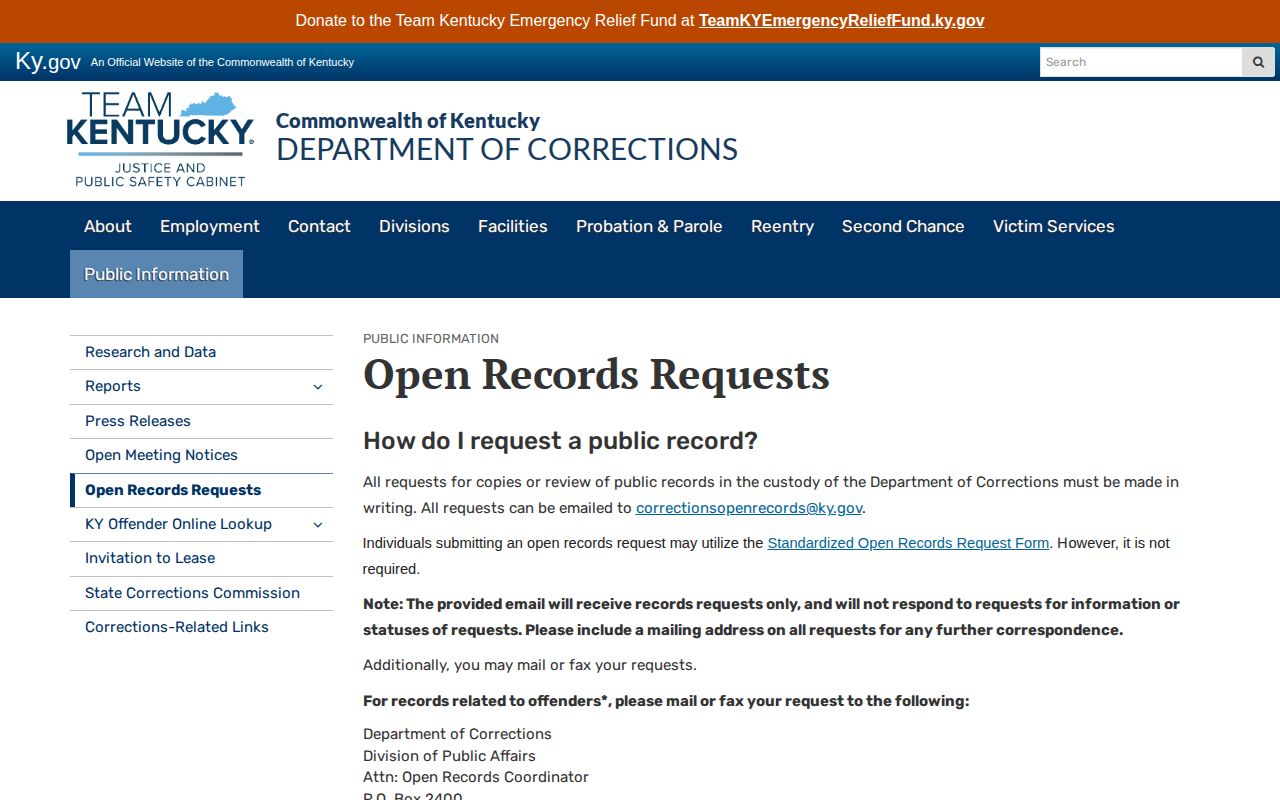
The request channel can supply an agency-created release or discharge record when a portal view is not enough.
Public Record Search
Sponsored Results
Keep the final confirmation with its date and source. That record separates an earlier estimate from the event that actually occurred.